
The Long And Winding Road To Achieve Diagnostic Excellence

Introduction. Background
Clinical practice has two main objectives, a correct diagnosis and a proper therapeutic decision. In the last three decades, the improvement in pharmaceutical resources has been impressive, together with a revolution in the diagnostics based on the image. But, on the other side, the theory of diagnostic improvement and clinical reasoning is still following a difficult path through the years. One of the reasons is the difficulty to
disentangle the complex mechanism that takes place inside the brain, associated with the process of clinical reasoning and clinical judgment. In this path to achieve a better teaching and learning of the process of reasoning and an improvement in the precision of diagnosis, there is a new queen in the room, the new tool of Artificial Intelligence (AI), a computational resource that can be able to change the landscape of science in general and medicine.
Going back on time. The pioners
In this path there are names who have played a key role trying to enhance the importance of the diagnostic process and the mechanism involved in the clinical reasoning process. Authors like Jerome Kassirer (1), Ronald Epstein and Borrell-Carrió (2), Jerome Groopman (3) and Pat Croskerry (4) are medical professionals internationally recognized as experts in the fields of medical education, clinical reasoning, clinical skills and doctor patient communication.
Although diagnostic excellence is a positive objective, the “trigger point” to study the possibility of improvement was initiated with the problem of medical error. Medicine has always been considered almost an exact science and doctors as infallible, but the truth is that physicians from every specialty have to deal with uncertainty and complex problems, and in the real world there is a lot of suffering for the professionals when they make a mistake. Albert Wu, from the Jonh Hopkins University in Baltimore, defined the concept of “second victims” to describe the situation, both personal and professional, when a clinician is involved in a medical error, and he was one of the first persons to speak and define a medical error (5). But the definitive evidence of the presence of adverse events and medical error in clinical practice came after the publication of the article by Brennan, Leape and Laird, published in 1991 in The New England Journal of Medicine, better known as The Harvard Medical Practice Study (6), where a 3,7% of hospital admissions involved adverse effects, considering that the medical record under review were dated as far as 1984. The impact of this article on newspaper and television in the United States brought the attention of journalists, clinicians and people in general, introducing the field of Patient Safety and Clinical Reasoning under the scope of the medical and people´s interest. Two names came to my memory that I would like to highlight, Donald M. Berwick, Director of the Institute for Healthcare Improvement (7), an institution that started online courses about Quality Improvement and Patient Safety, very well structured and clearly explained, and Dr. Robert Wachter, a champion in the dissemination of the concepts of patient safety in clinical practice with a constant activity as a speaker in different meetings and as a champion author of books and papers about the subject (8). In a personal review like this, based on my vital experience, I have to explain that other professionals, coming from the security in the industrial and clinical field such as Donald A.Redelmeier (9), Charles Vincent (10), Amalberti, Dietrich Dorner, Dr. James Reason, Dr. Lucian Leape, and medical educators like Dra. Caroline Lucey from the University of California San Francisco, all of them have been instrumental through their contributions to the field of patient safety and clinical reasoning.
The British School
The tradition of epidemiology in Britain is very well-known, and some publications around medical error, diagnostic delay, cancer diagnosis delay, medical education and cognitive biases, came from authors with a strong background in the epidemiological method or in psychology. Researchers such as Professor Giorgios Lyratzopoulos or Professor Silvia Mamede (11) and Professor Olga Kostopoulou are some of the names that came to my memory for their relevance in the research of diagnostic delay, medical education and clinical reasoning.
Clinical Error and Diagnostic Improvement
Error, improvement and a better knowledge of the clinical reasoning process are the foundation of the path to learn and teach to mitigate adverse events in the clinical environment and to reduce suffering, both to the patients and to the practitioners. In the last two decades in the United States of America, a group of clinicians, headed by Dr. Mark L. Graber (12), started an organization, Community to Improve Diagnosis, devoted to the research, learning and study of the process of diagnostic, analyzing the complex mechanisms of clinical reasoning and cognitive biases, trying to give a broad view of the situation in terms of improvement, patient safety and patient participation, an effort supported by colleagues (and Dr. Graber´s friends), such as Dr. Hardeep Singh, Dr. Gordon Schiff, Dr. David Newman-Toker, Dr. Olson and professor Laura Zwaan. They created a web page with a lot of resources in the field (8), published the book “Diagnosis” and they keep the journal Diagnosis, published monthly. Every year there is a Workshop now under the structure of an organization called “DEX”, Diagnostic Excellence.
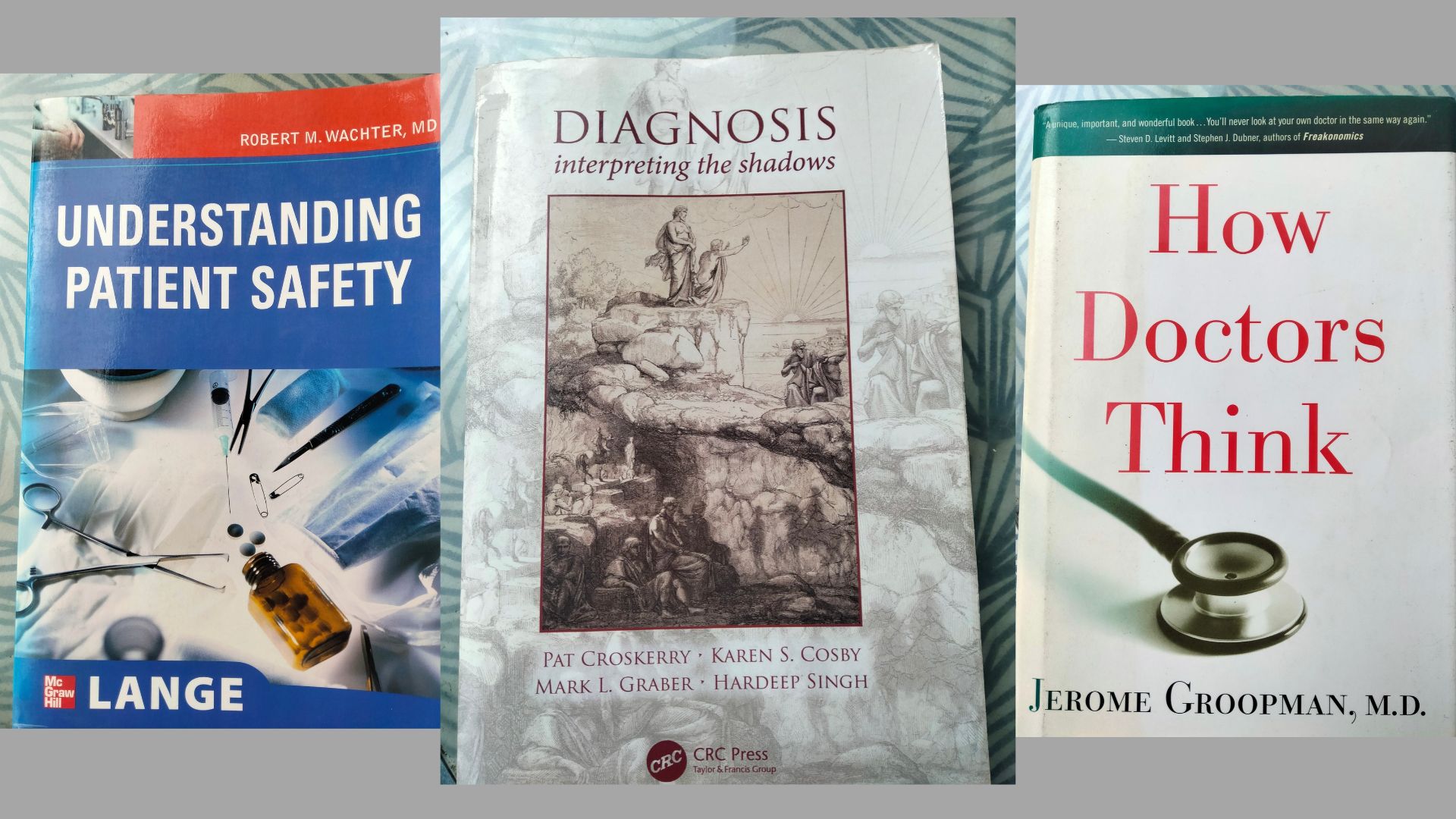
In my opinion, Dr. Mark L. Graber work has been definitive to shed light to the complex and underestimated world of the diagnostic process, and the organization that he funded is the lighthouse for everyone interested in the improvement of the diagnostic process, for both professionals and the general public.
Bibliography
- Book: Kassirer JP. Learning Clinical Reasoning.
2) Borrell-Carrió F, Epstein RM. Preventing Errors in Clinical Practice: A Call for Self-Awareness. annals of Family Medicine. 2004; 2(4): 310-316.
3) Groopman J. How Doctors Thinh. New York: Hougton Mifflin Company, 2002
4) Croskerry P. The importance of cognitive errors in diagnosis and strategies to minimize them. Acad Med 2003; 78: 775-780
5) BMJ vol 320 (18) MARCH 2000
6) The New England Journal of Medicine Feb. 7, 1991:370
7) Institute for Healthcare Improvement
8) Understanding Patient Safety. Robert W. Wachter. Lange. McGraw-Hill Companies.ISBN 978-0-07-148277-6
9) Redelmeier DA. The cognitive psychology of missed diagnoses. Ann Int Med 2005; 142: (2): 115-119
10) Vincent C., et al. Safety measurement and monitoring in healthcare. BMJ qual saf 2014; 23(8): 670-67
11) Mamede S. Diagnostic errors and reflective practice in medicine. J Evaluation in Clin Practice 2007; 13: 138-145
12) Graber,M. Reducing diagnostic errors in medicine.:what´s the goal? Acad Med 2002; 77(10):981-992
Author
Dr. Lorenzo Alonso-Carrión
FORO OSLER