

How To Disentangle a Diagnostic Error: A Narrative Clinical Case

Objective
To describe some factors associated with the resolution of a diagnostic error case that went undiagnosed for more than six months. Although comparison or explanation around this clinical case can´t be generalized or applied to other situations, some of the factors described here are quite often found in different environments.
Clinical Case
A 37-year-old healthy man, without toxic habits, started with a strong unilateral headache on the right temporal and parietal areas of the skull. The pain was very intense, lasted for several minutes without fever or vomiting, and it was progressively going down with a pain killer, but the symptom reappeared in episodic form, at least monthly during one six-month period.
Clinical Evolution
The patient was living in Germany at that time, and he asked for a diagnosis in different visits to his private doctor. He received a diagnosis of migraine, and he started treatment without improvement. He had to quit his job because of the pain.
He went to Spain, where he was born, and in an episode he went to the Emergency Department because of the pain. The doctor in charge, after an assessment and physical examination, asked for a CT scan. He recorded the number of visits in Germany and the lack of a brain image, probably because the doctor there never thought about a dangerous diagnosis or because he wanted to save diagnostic tests.
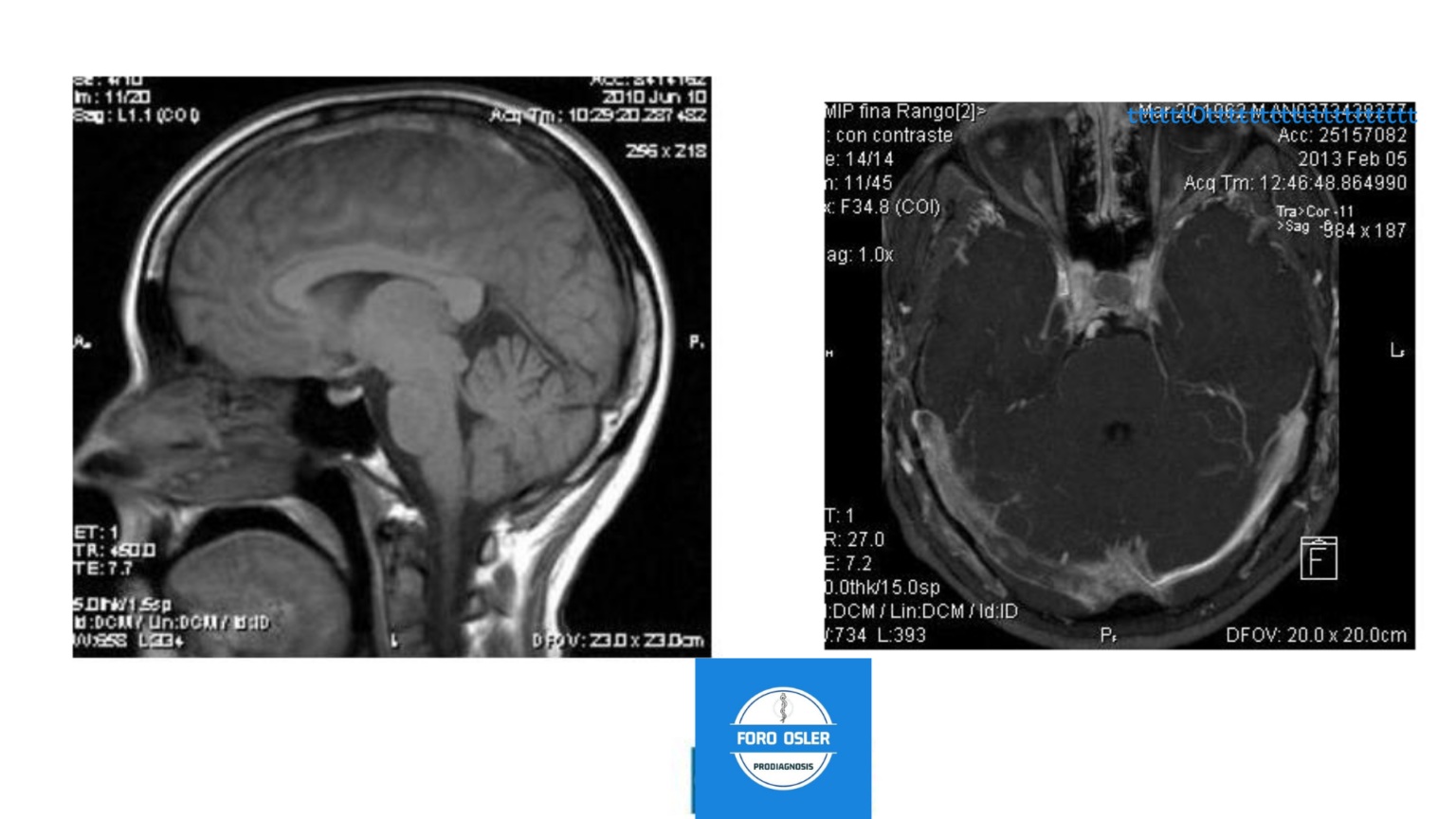
The CT scan showed an image compatible with a cranial venous thrombosis on the right side of the brain, and this was confirmed after a nuclear magnetic resonance.
Analysis
We can classify the situation as a Diagnostic Error in relation to a delayed diagnosis. We will try to examine some key points that could be associated with this diagnostic error.
-Uncommon diagnosis: a cranial venous thrombosis is a very rare diagnosis in a healthy patient, without coagulation problems.
-Scarcity of symptoms: Headache is the most frequent symptom associated with multiple intracranial diagnoses, and the diagnosis is even more difficult when no other signs or symptoms are present.
-Private or public system: this is a controversial aspect of medical diagnosis. It is clear that, in general, private medical practice is more related to economical benefit, and this sometimes, can produce one situation where the professional is “biased” against asking for a test. This is only a possibility without confirmation.
– Number of visits: the number of visits for the same clinical problem has been established as a determinant factor for a diagnosis delay (1), mainly in cancer. But, to recognize this factor, the provider must be really aware of this situation, asking in an active way during the anamnesis or looking in detail in the medical records. This particular variable can be easily detected by Artificial Intelligence.
Bibliography
Author
Dr. Lorenzo Alonso Carrión
FORO OSLER